As industries continue their digital transformation journeys, connectivity has become a critical enabler of operational efficiency, automation, and innovation. While public cellular networks provide reliable connectivity for consumers and businesses alike, many organizations require greater control, security, and performance than a public network can offer. This is where Private 5G Networks come into play.
Private 5G has rapidly emerged as one of the most transformative technologies for enterprises seeking to support smart manufacturing, logistics automation, industrial IoT, autonomous vehicles, and mission-critical operations.
In this article, we explain what a Private 5G Network is, how it works, and why organizations across multiple industries are adopting this technology. .
What Is a 5G Private Network?
A Private 5G Network is a dedicated cellular network built exclusively for a specific organization, site, or operation. Unlike public mobile networks operated by telecommunications service providers, a private network is designed to serve the connectivity needs of a single enterprise.
The organization can own, manage, and control the network infrastructure or work with a telecom partner to deploy and operate it.
Private 5G networks use the same advanced technologies and standards as public 5G networks, but they provide dedicated resources, customized coverage, enhanced security, and greater control over network performance.
Examples of environments where Private 5G is commonly deployed include:
- Manufacturing facilities
- Airports
- Seaports
- Warehouses and logistics centers
- Mining operations
- Energy and utility sites
- University campuses
- Large enterprise campuses
How Does a Private 5G Network Work?
A Private 5G Network consists of several key components working together to provide seamless wireless connectivity.
1. Radio Access Network (RAN)
The Radio Access Network includes the radios and antennas that provide wireless coverage throughout the facility.
These access points connect smartphones, tablets, sensors, cameras, robots, vehicles, and industrial equipment to the network.
Depending on the size and requirements of the site, coverage can be provided through:
- Outdoor macro cells
- Small cells
- Distributed Antenna Systems (DAS)
- Indoor coverage solutions
2. 5G Core Network
The 5G Core acts as the intelligence behind the network.
It manages:
- Device authentication
- Security policies
- Network traffic
- User access
- Quality of Service (QoS)
The core can be deployed on-premises, in a private cloud, or through a hybrid architecture.
3. Spectrum
Private 5G networks operate using licensed, shared, or locally assigned spectrum depending on the regulations of each country.
The availability of spectrum varies by region, but many governments have introduced dedicated spectrum programs to encourage enterprise adoption.
4. Connected Devices
A wide range of devices can connect to a Private 5G Network, including:
- Industrial sensors
- Autonomous guided vehicles (AGVs)
- Surveillance cameras
- Mobile workforce devices
- Industrial robots
- IoT gateways
- Drones
Why Are Enterprises Adopting Private 5G?
Organizations are increasingly deploying Private 5G because traditional connectivity technologies often struggle to support modern industrial applications.
Enhanced Security
Private 5G networks offer greater control over user access, data traffic, and network policies.
Sensitive operational data can remain within the organization's environment, reducing exposure to external threats.
Reliable Coverage
Unlike Wi-Fi networks that may experience interference or coverage gaps, Private 5G delivers predictable and consistent connectivity across large indoor and outdoor environments.
Low Latency
Many industrial applications require real-time communication. Private 5G can support low-latency applications such as:
- Robotics
- Machine automation
- Autonomous vehicles
- Remote operations
- Massive Device Connectivity
Private 5G can support thousands of connected devices simultaneously without compromising performance.
This makes it ideal for Industrial IoT deployments.
Mobility
Private 5G enables seamless mobility across large facilities without requiring users or devices to switch between multiple networks.
Private 5G vs Wi-Fi: What's the Difference?
While Wi-Fi remains an important connectivity technology, Private 5G offers several advantages in large-scale enterprise environments.
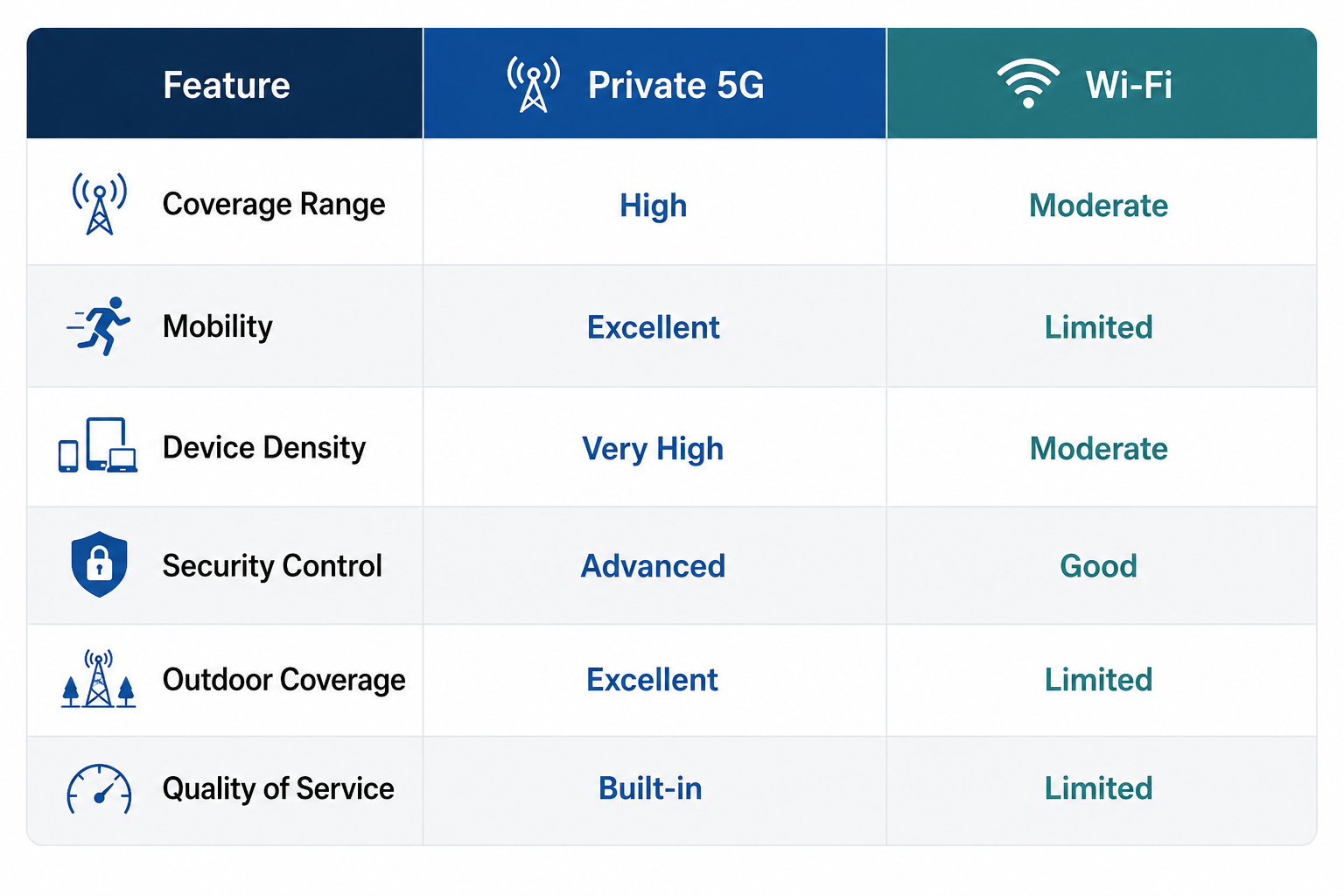
Many organizations are adopting a complementary approach where Private 5G and Wi-Fi coexist to support different applications.
Which Industries Benefit Most from Private 5G?
- Manufacturing: Smart factories use Private 5G to connect machines, robots, sensors, and workers in real time.
- Logistics and Warehousing: Private 5G enables automated inventory management, autonomous vehicles, and real-time asset tracking.
- Airports: Airports use Private 5G to improve operational efficiency, enhance passenger services, and support critical communications.
- Mining: Mining operations rely on Private 5G for autonomous equipment, worker safety systems, and remote monitoring.
- Utilities and Energy: Power plants and utility operators use Private 5G to support monitoring, maintenance, and operational control systems.
The Future of Private 5G
As Industry 4.0 initiatives continue to accelerate, Private 5G is becoming a foundational technology for digital transformation.
Organizations are moving beyond simple connectivity and leveraging Private 5G to enable:
- Artificial Intelligence (AI)
- Industrial automation
- Digital twins
- Autonomous operations
- Predictive maintenance
- Advanced analytics
With increasing demand for secure, reliable, and scalable wireless connectivity, Private 5G is expected to play a central role in the next generation of enterprise networks.
Private 5G Networks provide organizations with a powerful platform for secure, reliable, and high-performance wireless connectivity.
By combining dedicated network resources, enhanced security, seamless mobility, and support for massive numbers of connected devices, Private 5G enables enterprises to accelerate digital transformation and unlock new levels of operational efficiency.
Whether deployed in a factory, airport, warehouse, utility site, or industrial campus, Private 5G offers the flexibility and performance required to support today's connected operations and tomorrow's innovations.
Frequently Asked Questions
What is the difference between Private 5G and Public 5G?
Public 5G networks are operated by mobile network operators and shared among many users. Private 5G networks are dedicated to a specific organization, providing greater control, security, and performance.
Is Private 5G more secure than Wi-Fi?
Private 5G typically offers stronger authentication mechanisms, advanced security controls, and better network segmentation, making it highly suitable for enterprise and industrial environments.
Can Private 5G replace Wi-Fi?
Not entirely. Many organizations use Private 5G and Wi-Fi together. Private 5G excels in mobility, coverage, and industrial applications, while Wi-Fi remains effective for office environments and indoor data access.
What devices can connect to a Private 5G Network?
Smartphones, tablets, industrial sensors, cameras, robots, autonomous vehicles, IoT devices, drones, and other 5G-enabled equipment can connect to a Private 5G Network.
Do Private 5G Networks require licensed spectrum?
Not always. Depending on local regulations, Private 5G networks can use licensed, shared, or locally assigned spectrum.
Which industries benefit most from Private 5G?
Manufacturing, logistics, mining, transportation, airports, utilities, energy, healthcare, and higher education are among the industries seeing significant benefits from Private 5G deployments.
How long does it take to deploy a Private 5G Network?
Deployment timelines vary depending on the site's size and complexity. Small deployments may take a few weeks, while larger industrial projects can require several months.
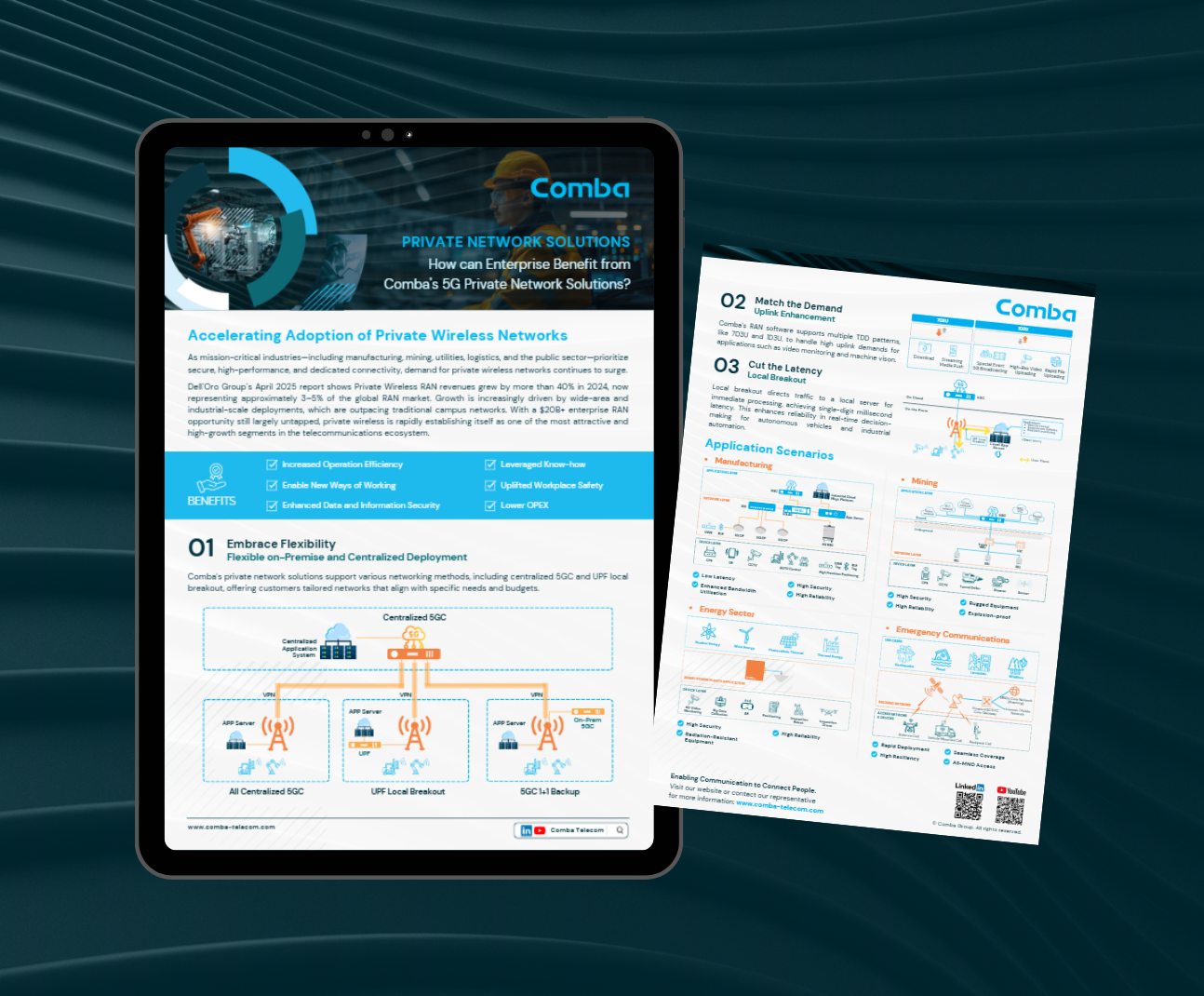
Comba Private Networks Solution
|
|
➡️ Download the Brochure Here |