


Delivering High-Capacity Wireless Connectivity for 20 Million Annual Passengers
Modern airports have evolved far beyond transportation hubs. Today, they operate as highly connected digital environments where passengers expect uninterrupted mobile connectivity throughout every stage of their journey—from check-in and security screening to retail areas, lounges, boarding gates, and parking facilities.
Meeting these expectations requires much more than basic cellular coverage. Airports must accommodate growing data consumption, support multiple mobile operators, enable emerging 5G services, and maintain reliable communications across a wide range of operational environments. At the same time, they must deliver a seamless experience for millions of travelers moving through the facility each year.
These challenges became particularly important for one of Southeast Asia's busiest international airports as it prepared to open a new terminal spanning approximately 120,000 square meters and designed to serve up to 20 million passengers annually. The airport needed a wireless infrastructure capable of supporting both current and future connectivity demands while avoiding the complexity and cost associated with multiple standalone operator deployments.
To achieve this, the airport partnered with Comba Telecom to implement a shared multi-operator 5G Distributed Antenna System (DAS), creating a future-ready platform capable of supporting multiple generations of wireless technology on a single infrastructure.
The Challenge: Building the Region's First Shared Multi-Operator 5G Airport Network
Designing wireless connectivity for a modern airport is rarely straightforward. Large open spaces, commercial areas, security checkpoints, baggage handling zones, parking structures, and passenger lounges all present unique RF challenges that require careful planning and optimization.
In this case, the airport's vision extended beyond simply providing coverage. The objective was to create a shared infrastructure capable of supporting multiple mobile operators simultaneously while delivering a consistent user experience throughout the terminal.
The solution also needed to accommodate both legacy and next-generation technologies. Alongside existing 3G and 4G services, the airport wanted to enable advanced 5G capabilities, including LTE 2×2 MIMO and 5G NR 4×4 MIMO configurations, without requiring separate systems for each technology.
As one of the region's first shared multi-operator 5G airport deployments, expectations were exceptionally high. The network needed to perform flawlessly from day one, providing reliable connectivity for passengers while creating a scalable foundation for future growth.
The Solution: ComFlex Max Active DAS
To meet these requirements, Comba Telecom deployed its ComFlex Max Active DAS platform. Designed specifically for high-capacity, multi-operator environments, the solution enabled shared 3G, 4G, and 5G connectivity across the entire terminal while simplifying infrastructure management and long-term operations.
Rather than deploying separate systems for each operator, ComFlex Max allowed all participating mobile operators to share a common DAS platform. This approach significantly reduced infrastructure duplication, optimized equipment room utilization, and simplified ongoing network management.
The deployment was carefully tailored to the unique characteristics of different airport environments. High-density passenger areas were designed using 4×4 MIMO configurations to maximize 5G capacity and throughput, ensuring strong performance during peak traffic periods. In lower-density areas such as parking facilities, 2×2 MIMO configurations provided efficient and reliable coverage while optimizing resource utilization.
Successful delivery also depended on close collaboration between multiple stakeholders. Throughout the project, Comba Telecom worked closely with airport authorities, mobile operators, and the neutral host provider during site surveys, RF design, deployment, commissioning, and validation activities. This coordinated approach ensured the network was fully operational before the terminal officially opened.
Results: A New Benchmark for Airport Connectivity
The completed deployment established a new benchmark for airport wireless connectivity in Southeast Asia by demonstrating how multiple operators and multiple generations of wireless technology can successfully coexist on a single infrastructure platform.
One of the most significant outcomes was the creation of a truly shared multi-operator environment. By supporting multiple operators on the same DAS, the airport reduced infrastructure complexity while creating a more efficient model for future expansion.
The platform also consolidated legacy, current, and next-generation wireless technologies into a single architecture. This gives operators the flexibility to evolve their services over time without requiring major infrastructure changes or costly hardware replacements.
From a future-readiness perspective, ComFlex Max supports advanced MIMO configurations and frequency bands up to 3.5 GHz, providing a strong foundation for future 5G services, enterprise applications, and emerging connectivity requirements.
The deployment's flexible architecture further optimized performance by strategically combining high-power and low-power units throughout the terminal, ensuring coverage and capacity were delivered where passenger demand was highest.
Verified 5G Performance
Performance validation confirmed the effectiveness of the deployment across the airport terminal.
On-site testing recorded downlink throughput exceeding 800 Mbps and uplink throughput above 160 Mbps while maintaining seamless connectivity across all participating mobile operators.
These results help ensure passengers can enjoy high-quality mobile experiences throughout their journey, including video conferencing, HD streaming, mobile applications, digital ticketing, and other bandwidth-intensive services that have become essential to modern travel.
Why Shared Multi-Operator DAS Is the Future of Airport Connectivity
As airports continue their digital transformation journeys, the demand for reliable, high-capacity wireless connectivity will only increase. Passenger expectations continue to rise, while airports themselves are becoming increasingly dependent on connected applications, digital services, and real-time operational systems.
In this environment, shared infrastructure models offer a compelling alternative to traditional operator-specific deployments. By allowing multiple operators to share a common DAS platform, airports can reduce infrastructure duplication, lower deployment and operational costs, simplify network management, accelerate 5G adoption, and deliver a more consistent experience for passengers.
Perhaps most importantly, a shared DAS creates a scalable foundation that can evolve alongside future connectivity requirements. As new technologies emerge and data demands continue to grow, airports can expand capacity and introduce new services without fundamentally redesigning their wireless infrastructure.
This project demonstrates how a carefully planned multi-operator DAS strategy can help large transportation hubs meet today's connectivity demands while preparing for tomorrow's opportunities.
Download the Full Case Study
The full case study explains how ComFlex Max is helping airports, transportation hubs, and large venues prepare for the next generation of wireless connectivity.
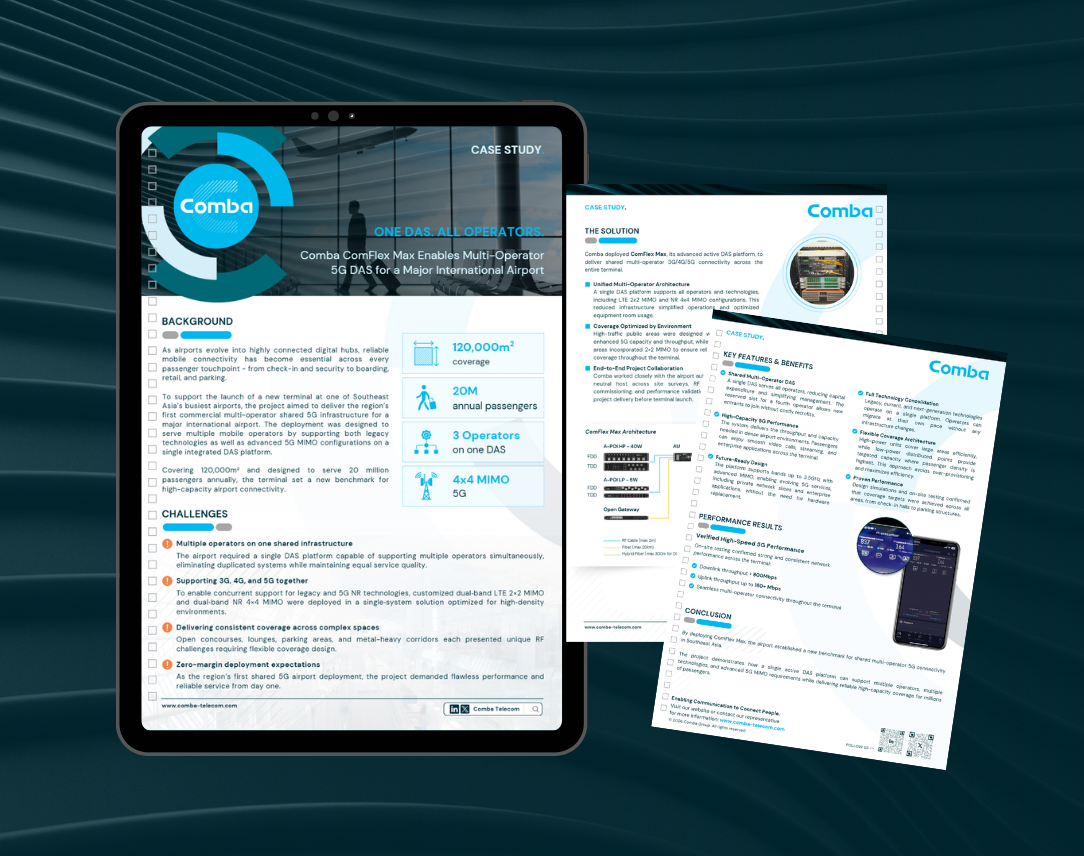 |
➡️ CASE STUDY: One DAS. ALL Operators. Comba ComFlex Max Enables Multi-Operator 5G DAS for a Major International Airport. |
Frequently Asked Questions
What is a Multi-Operator DAS?
A Multi-Operator Distributed Antenna System (DAS) allows multiple mobile network operators to share the same wireless infrastructure, reducing costs while maintaining service quality for all users.
Why do airports need a DAS solution?
Airports contain large indoor spaces, high passenger densities, and complex architectural environments that can limit cellular signal penetration. DAS ensures reliable coverage and capacity throughout the facility.
Can a DAS support both 4G and 5G?
Yes. Modern Active DAS platforms such as ComFlex Max support multiple wireless technologies simultaneously, including 3G, 4G LTE, and 5G NR.
What is the benefit of a shared infrastructure model?
Shared infrastructure reduces capital expenditure, minimizes equipment duplication, simplifies operations, and allows multiple operators to serve users through a common platform.
What is 4×4 MIMO and why is it important?
4×4 MIMO (Multiple Input Multiple Output) uses multiple antennas to increase network capacity and throughput, making it particularly valuable in high-density environments such as airports.
How many operators can be supported on a shared DAS?
The number depends on the platform design. In this deployment, three operators were supported on a single DAS, with capacity reserved for future expansion.
What performance was achieved in this airport deployment?
On-site testing verified download speeds exceeding 800 Mbps and upload speeds above 160 Mbps while maintaining seamless multi-operator connectivity throughout the terminal.
Where can I learn more about this project?
Download the full case study to explore the architecture, deployment approach, performance validation, and business benefits achieved with ComFlex Max.